
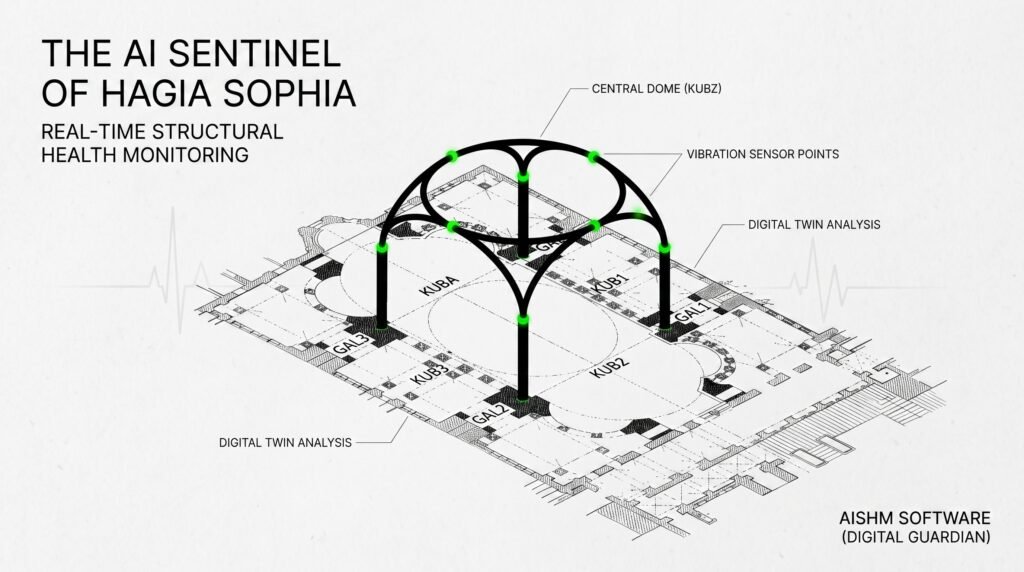
For nearly a millennium and a half, the colossal dome of the Hagia Sophia has dominated the Istanbul skyline, silently weathering empires, crusades, and countless seismic events. But preserving such a monumental masterpiece requires more than just reverence; it demands proactive, cutting-edge sentinelship. While visual inspections and reactionary repairs have been the standard for centuries, the digital age introduces a sophisticated new protector: AISHM (Artificial Intelligence in Structural Health Monitoring).
AISHM is not merely software; it is a pioneering dynamic sentinel designed to ensure the structural resilience of our most precious cultural heritage. It represents the perfect synthesis of ancient architectural wisdom and 21st-century technological innovation.
The AI Sentry: A New Era of Vigilance
Traditionally, detecting damage in complex masonry structures like the Hagia Sophia has been a reactionary process—engineers found problems only after they became visible. AISHM transforms this paradigm into a proactive one. The core philosophy of this AI-driven sentinel is simple yet profound: Vigilance through Real-Time Synthesis.
This state-of-the-art software continuously monitors the structure, effectively learning the masterpiece’s normal, healthy “heartbeat” under all conditions. Here is how AISHM operates as Hagia Sophia’s tireless digital guardian:
- Real-Time Environmental Integration: AISHM doesn’t monitor the building in isolation. It continuously digests real-time atmospheric data, sourcing atmospheric parameters like temperature, humidity, wind speed, and precipitation from the Turkish State Meteorological Service (MGM) and open-source global APIs. This contextual data allows the AI to understand the structure’s state relative to its immediate environment.
- Continuous Dynamic Synthesis: Using advanced neural networks, AISHM takes this live environmental context and predicts, down to the millisecond, what the building’s specific vibrational frequencies should be. It then continuously compares these AI-driven predictions against the actual real-time vibrational data flowing from sensors placed on the monument.
- Proactive Anomaly Identification: This is the crux of the AISHM advantage. If the measured frequencies deviate from the AI’s predicted behavior, the software instantly flags it as an “anomaly”. This early warning allows engineers to identify and investigate potential underlying damage—such as micro-cracking or structural shifts—long before they escalate into visible, costly, or dangerous failures.
Seismic Choreography: The Earthquake Tracker Module
Hagia Sophia’s primary threat has always been sismik aktivite. Beyond daily atmospheric sentinelship, AISHM includes a robust Earthquake Tracker Module. This specialized tool performs two critical functions:
- Instant Seismic Assessment: During an earthquake, AISHM instantly captures the building’s dynamic response. It goes beyond just recording strong motion; it analyzes how the seismic energy is processed by the domes, arches, and main piers.
- High-Fidelity 3D Visualization: The module transforms raw sensor data into high-fidelity, real-time 3D animations of the structure’s actual displacements during the event. This provides engineers with immediate, accurate visual insights into which parts of the masterpiece experienced the most stress and displacement, facilitating rapid and targeted post-earthquake inspections.
AISHM represents the vanguard of modern structural preservation. It is not just about collecting data; it is about synthesized intelligence that empowers us to look over Hagia Sophia’s shoulder, ensuring her resilience continues for another thousand years.